Archive for the 'ideas' Category

starting up again

Sunday, January 14th, 2007

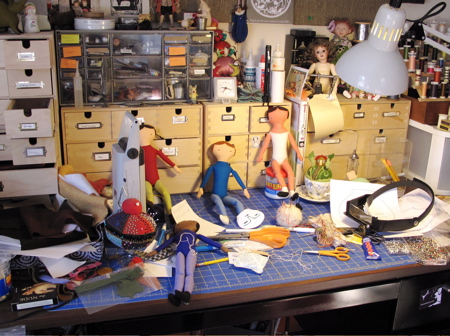
This is my desk after I cleaned up. Yes. It is.114deskb.jpg

I know it really isn’t cleared off. It must have been for a minute or two, but then I got started on something. While I was clearing things, I kept finding little sketches that I’ve done in the past few months- things I was thinking about, but I was in the middle of something else.114ideas.jpg

Now that it is time to get back to work, there are so many possible directions to go in. Which ever one I chose will very likely lead me down a path where these other ideas get forgotten or at least delayed a lot longer. They are all calling to me! So, I freeze up. But I know it is important to do something, anything, start somewhere. Start on the thing that has a deadline of sorts. So I am making Valentine postcards and Valentine robots-
114table.jpg

above, that is my work table. Below, the ironing board. All surfaces are covered again. In my studio, that seems to be a good thing.

114postcards.jpg

getting inspired

Wednesday, November 15th, 2006

In the last few days, I’ve had several people ask what inspires me so I thought it might be a good idea to post about it, i.e. give it some actual thought. Years ago I took my son to a talk given by Philip Pullman. He was absolutely brilliant. One of the things he talked about was that people often ask where he gets his ideas. He said something along the line of- the ideas come to my desk and if I’m there, I get them. If I’m not, I don’t. I loved that explanation! So much of the art is just being at your desk and working. I googled “Philip Pullman inspiration” and I didn’t get that story but got this explanation. (the first paragraph) Not as funny but also excellent.

I am inspired by materials (these days beautiful fabrics), things that I touch (robots with the sewing notions for details), the seasons, the little stuff going on in my life everyday, some odd thing that I’ve read about (example- fat fairies), the photos of what everyone else is doing all over the craft blogging world and Flickr, a new technique that I’ve learned, my family, color. And if I am working on something, and if it doesn’t have a face, I probably won’t stay interested for too long! If I hit a dead end, I have 2 ways of recharging that usually work. I go back to my older work, look through it and try to come up with a new approach or simply do another one. I have found lots of inspiration for the postcards by going through old photos of my pottery. The other technique is to go through all my materials. That way I get 2 things accomplished- clear out some stuff and almost always find something that sparks an idea.

I didn’t know that…

Thursday, March 16th, 2006

It never occured to me that you could use that double sided iron-on stuff- you know, like Wonder Under- to stick fabric onto cardboard. We had a demo at doll club a few weeks ago and we all got a pattern and directions to make this- a folding bin, very handy for a trashcan at a workshop. Here is is open-

open

and closed-

closed

Names

Monday, May 9th, 2005

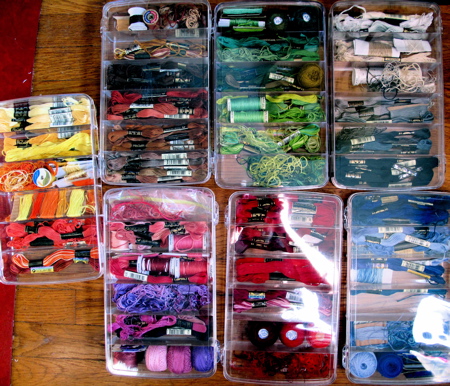
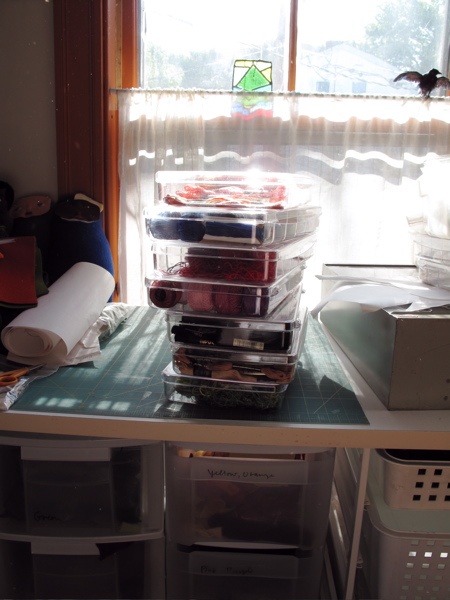
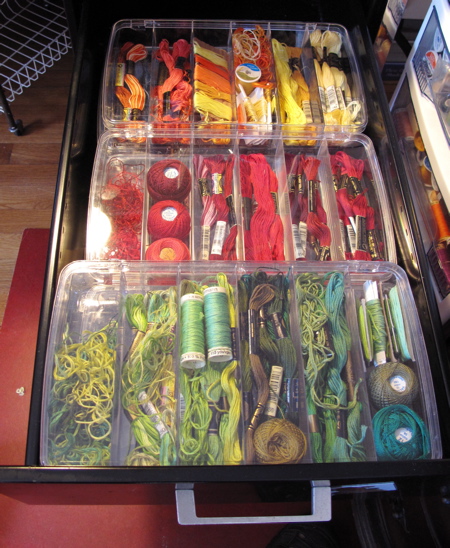
I am in the midst of a massive clean-up and reorganization of my studio. I was feeling like I was drowning! And I couldn’t find anything. I really should go through all my stuff once a year just so I remember what I’ve got. It is very inspiring.

I enjoyed the post on names over on Wee Wonderfuls and thought I’d post something I’d saved from one of the Yahoo groups I read. Someone sent in a list of names that was printed in UFDC’s “Dolls News” in an article from August 1959. The list was gleaned from The Godey’s Ladies Book of 1857. On some of them, I’m not sure if the spelling is correct so I’ve put a (?).

Alba, Adelia, Alida, Athalie, Annot, Arabella, Berthanalda (?), Corilia, Claribel, Clotilda, Clarina, Euphemia, Elfrida, Euphrasie, Eulalie, Endora, Elfie, Elmira, Emmeline, Esmeralda, Ermengarde, Linette, Fidelia, Florinda, Floribelle, Fennilla (?), Georgianna, Hermione, Hortense, Hilda, Ione, Imogene, Imalda, Lanthe, Isodora, Keziah, Lilla, Lucretia, Letitia, Minnie, Maude, Mara, Maja, Melecent, Medora, Myrrha, Mira, Nyia, Parthenia, Selina, Sara, Sophronia, Telkla, Thyrza, Victorine, Zara, Zitelle, Zelica, Zayda, Amy, Agatha, Aurelia, Annabel, Aimee, Alida, Angeline, Blanche, Cora, Camille, Cecily, Dora, Dorcas, Delia, Ella, Elfrida, Fanny, Gertrude (Trudy), Geraldine, Henre, Ida, Iona, Jeanette, Jessica, Juliet, Josephine, Katrina, Lydia, Marcia, Monica, Mildred, Matilda, Natalie, Naomi, Nydia, Olympia, Pamela, Penelope, Rosa, Rosalie, Rowena, Renee, Rosabella, Rosette, Sylvia, Sybil, Sophia, Susette.

I am going to use one of these names for my latest doll- you can try to guess which one. I will show her with her name once I get her shoes done.

cat softies

Wednesday, January 12th, 2005

Loobylu has a Month of Softies project that anyone can join in on. This months theme is vintage catwalk. I have been thinking about participating this month.

Over the years I have done a lot of “cat art”(?)…
on hats-

cat hat

sweaters-

cat sweaters

pottery-

cat bowl

I am going to try to knit a kitty- knitted stuffed animals always have a vintage look in my eyes.

knit cat

I was really pleased to find this image-

jazz cat

in Meggiecat’s blog… which I found through In a Minute Ago- a treasure trove of valuable links and information! The blue sweater is excellent!

notes on ladies

Saturday, December 4th, 2004

I said a few days ago that I was going back to work on my mannequin doll and am trying to improve the pattern. These dolls are inspired by antique wooden dolls, but then they are also leaning toward some early china dolls. The right hand doll is Angela undressed. She was the first one I made in the series. When I made her male companions, I made some improvements, and now I want to make a better lady doll. On the left is the same pattern with better feet… the limbs are not attached yet- she is all just pinned together.

mannequin 1 and 2

My improved feet are the same as the male version. There is a separate sole on the foot, and a piece of cardboard inside so it keeps it’s shape. In my next version, I have made the foot slightly smaller and the calf a bit thinner. Also changed is the knee joint- aiming for something closer to what a carved wood joint might look like.

I wanted a more “womanly” figure. I adjusted the pattern for the body front- I widened the front body piece and adjusted the darts. I ended up with the right hand torso. My most recent copy of Antique Doll Collector magazine has an article on early china doll heads and I just had to try adding a bun!

body 2 and 3

side view

and I changed the arm so that it only has one side seam. Simpler is better.

arms

trying to get organized

Tuesday, October 19th, 2004

I have been working on the photo gallery for my virtual open studio, but after I took the first set of pictures, I realised you couldn’t really see much except piles of stuff (ADD decorating). So… even though I had originally thought that the beauty of a virtual tour would be that I wouldn’t have to clean up, that is exactly what I worked on all day yesterday!

I am always trying to be organized as I work, but it is a constant struggle. I make parts of the doll and then, a month later can’t figure out which of my patterns I used. As I work on the dolls, paper pattern pieces are always disappearing- where did this disappearing paper come from anyway??? When I sew the cloth pieces together and stuff them, they can change shape dramatically, so trying to match paper to 3-d form usually doesn’t work.

I have made a lot of baby steps towards being organized with the patterns. I have all my doll pattern pieces numbered and organized in a notebook in plastic sleeves. I mark the pieces as I cut them out- but that part of the fabric ends up on the inside so that doesn’t help. I have tried marking the dolls on the bodies, but it seems like messing them up.
This is my latest idea-

10:19:orgsystem.jpg

I got these file sleeves at Staples. I put every piece of pattern paper and muslin mock-up into it. I trace the body pattern pieces onto a new paper and put that in also. I could use the outside to make notes, but haven’t gotten there yet. I use it as a way of cleaning as I go along… just put everything in the sleeve and then when it turns out something I need is lost, well, I know where to look!

my creative process?

Thursday, July 29th, 2004

birdshoes.jpg

The individual parts of this doll seem to be finished and I am feeling very dissatisfied. It might worry me except that it happens every time I get to this part of the project.
I keep thinking of E’s essay on the writing process. Different but the same.
My process goes something like this- Something plants the seed of an idea; a photograph, a painting, a piece of fabric or trim. The idea ferments, usually for months. Finally I get to work. I go through waves of satisfying flow and then frustration until I get to this point and I hate what I’ve done… then I tweak it and can usually get to a place where I am happy.
So…
I am looking at what I’ve got. The face needs something. I keep seeing a shadow of Michael Jackson. Scary. Maybe it’s the hair. The hair isn’t right… hmm. A hat? Would that make the difference? The pants need to be shortened. They are rolled in this picture. The cape? Lining? An environment?
Oh, jeesh, I don’t know.

Doll Bases

Sunday, May 9th, 2004

This is an article I wrote for our doll club’s newsletter.

How I Make My Doll Bases

by Mimi Kirchner

I make dolls that do not stand on their own and are not posed. They just stand around and hopefully look pretty! When I send them out to a show, they need a stand for display, and I learned early on that the white stands that are available at the local Arts and Crafts store would not cut it. I have figured out that I can still buy my “cheapo” doll stands- I just have to dress them up.

Materials needed for doll stand project-

-1 commercially available doll stand in a size that will hold your doll. (illus. 1)
-a piece of foam core board- approx. 12” x 12” will probably be enough.
* note- I get free foam core and matt board scraps by asking at frame shops.
Tacky-Glue (or your favorite thick glue)
Fabric for top of stand- see ideas at the end
fabric for bottom of stand- “
decorative edging (optional)- “
Quilt batting- (optional)
cardboard pieces
black knit fabric- approx. 2” x 12” ( may have to be bigger depending on the size of your doll and how much of the stand will show)
Clamps- I use clothes pins, bull dog clamps from Staples, hair clips and spring clamps, depending on the job.

1. and 2.
pic1.jpg

Planning

1. Set your doll on the stand.
2. Consider your fabrics by placing choices under the doll’s feet. It is important that the fabric does not blend in with the feet and make them disappear!
In choosing a material, think about where you imagine your doll to be- in the kitchen?- tiles or linoleum, in the study- how about an oriental rug pattern. School- tile or cork(?), playground- grass or leaves. At the ball- parquet. And, how will the color and textures you use enhance your doll.
3. How big do you want your base?-
-The most important thing is that the doll is stable on it’s base- not at all tippy- even if tippy is the “look” you want.
-The base can define a bottom for an imaginary case around the doll. Think about how the doll would look if the walls actually were there. crowded and cramped?- too small. lost?- too big. (illus. 2)
-a tall, thin adult doll will look better on a smaller base then a shorter rounder child doll.
-The doll’s base is equivalent to a painting’s frame- it defines the place where the piece exists. Make sure your doll has a big enough space.
Some shape ideas-
formal look-
square with rounded corners
flat back, round front

less formal look-
oval
rectangle with rounded corners

Assembling

1. Remove the wire doll clamp from the stand and set aside. (there are other doll stands that have a removable upright shaft - take that off also)
2. Make a paper pattern to cut the hole in the fabric for the upright in your doll stand. (illus. 4)
-Lay a piece of paper under the base and trace and then cut out the circle.
-Lay the paper circle on top of the base. Fold back where the paper touches the upright. -Mark where the metal touches your paper. (A.)
-Move your paper to the back of the base and measure from the edge of the base to the edge of the upright. (B.)
-Your pattern should look like this (C.)-
Try to approximate the shape of the bottom of the upright as you connect the dots. (D.) Cut along your drawn line and try it onto the base. It should fit very closely. If it doesn’t, scotch tape over your cut and try again.
-Put the paper aside for now.

4. and 5.
pic2.jpg

3.Cut out your foam core to desired size and shape. To make nice curves, use things you have around the house- bowls and plates, for instance.
*how I make an oval-
traced 2 circles and straight lines to attach them.
4. Put a ring of glue around the bottom edge of your doll stand and place it on the foam core. In most cases your doll stand is placed so that it touches the middle of the back edge. (illus. 5)
5. (optional) Cut out a piece of quilt batting- I use a 1” thick poly- the same size as the foam core. I like the cushiony look this gives. It hides all evidence of the original base, especially if you are using a light material or paper. Cut a whole for the upright and slip it on.
6. Cut your top material so that you have AT LEAST 1” (2” is safer) larger then your foam core.
-Keeping in mind your extra fabric allowance, put your paper pattern onto the fabric and mark where your U-shaped cut will be. Do NOT cut in from the edge! Cut ONLY the U-shape. The less you cut, the neater the base will be. It is better to stretch your cut over the upright or to go back and make another clip then to cut it too big. Slip your top material over the upright and into place.
you now have-
________ top material
______ batting
___ base
______ foam core

7. Turn the base over and lay on the edge of a table so that the upright is pointing down, and the main part of the project is supported on the table.
You will now be gluing the fabric onto the bottom of the foam core. Put a line of glue around the edge about 1/2” in from the edge.
First fold down the largest areas you can- the straight line areas, if there are any. Then carefully clip and stick down the curved areas. Clamp as you go along. You will have to clip a lot of the fabric to make smooth curves. It is best if the fabric does not overlap because you will end up with a lumpy bottom on your base.
It is a good idea to protect the top fabric when you clamp- put something stiff between the fabric and the clamp- like a popsicle stick or stiff cardboard pieces.
Let everything dry before the next step.
*note- at some point you may have to put a dot of glue at the base of the upright if your cut-out flap just won’t stay down.
8. If you are going to put piping on the edge, glue it on now.
I often put a piece of cardboard into the center space created by gluing down the top fabric. This evens out the bottom- no dip in the center.
9. Choose your bottom material and cut to the size of your base. (no matter how carefully I try to do this step, I always end up having to do a little trimming after it is glued and dried- so be warned!) It is most important that the edges are securely glued. I put a line of glue about 1/4” in from the edge and then spread it toward the edge with a scrap of cardboard. Place your base onto the fabric. Fiddle until it is just right and then weight the whole thing with some heavy books until it is dry.
10. finishing the edge- I like to cover the place where the top fabric meets the bottom fabric. I have used upholstery edgings and piping, ribbon and artificial flowers, flower petals, and leaves. Glue them on and pin in place until they are dry.
11. Take the piece of black knit fabric and sew up the long edge to form a tube. Turn. Slip the tube over the upright piece.
12. Now, put it all together! Push the black fabric tube down toward the bottom of the upright and put the wire doll clamp back into place. Put your doll into it’s new “home”. Adjust the height of the wire holder. When the doll is just where you want it, put some tape at the place where the wire goes into the upright. This will keep it from slipping around. Pull the black fabric sleeve back up to cover the upright. You are done!

stack2.jpg

Some material ideas for top fabrics-
-Upholstery fabrics
-artist canvas- you can paint it any way you like
-ultra-suede
-cork sheeting
-“grass” paper used for model railroad setups. If it is shedding like mine was, paint it with clear acrylic or modge-podge
-rice paper
-wood veneer
-doll house supply papers- can look like grass, wood, tile, carpet etc.!

Materials for bottom of base
-felt
-cork sheeting
-ultra suede
-matt board

finish edging
-ribbon- velvet looks very nice
upholstery edging
-any piping
-fabric or silk flowers, leaves or petals

petticoat pattern

Monday, March 29th, 2004

petticoat.jpg

A pattern for Clover’s petticoat. 11 1/2″ doll

This petticoat is made out of a nice, old linen handkerchief that already had a lace edge on it.
(step 0- go to your stash, sort through the 500 vintage handkerchiefs you have and pick out a nice plain one with small scale lace on the edge!)
1. Cut the lace off the side edges of the handkerchief.
2. Fold the handkerchief in half and cut across about 1/2 inch from the top. This gives you a one inch wide strip which will be the waistband.
3. Sew the side seams. Stop sewing about one inch from the top on one side.
4. Measure the doll’s waist. Gather the top edge to fit the doll.
5. Sew the waistband onto the gathered edge- first from the inside and then topstitch on the outside. Hand basting helps. Use a button, snap or hook for a closure.
Iron and your done!